She Who Haunts the Ford: A Deep Dive into the Morrigan
Mythology Classroom | KAEs Studio Creations
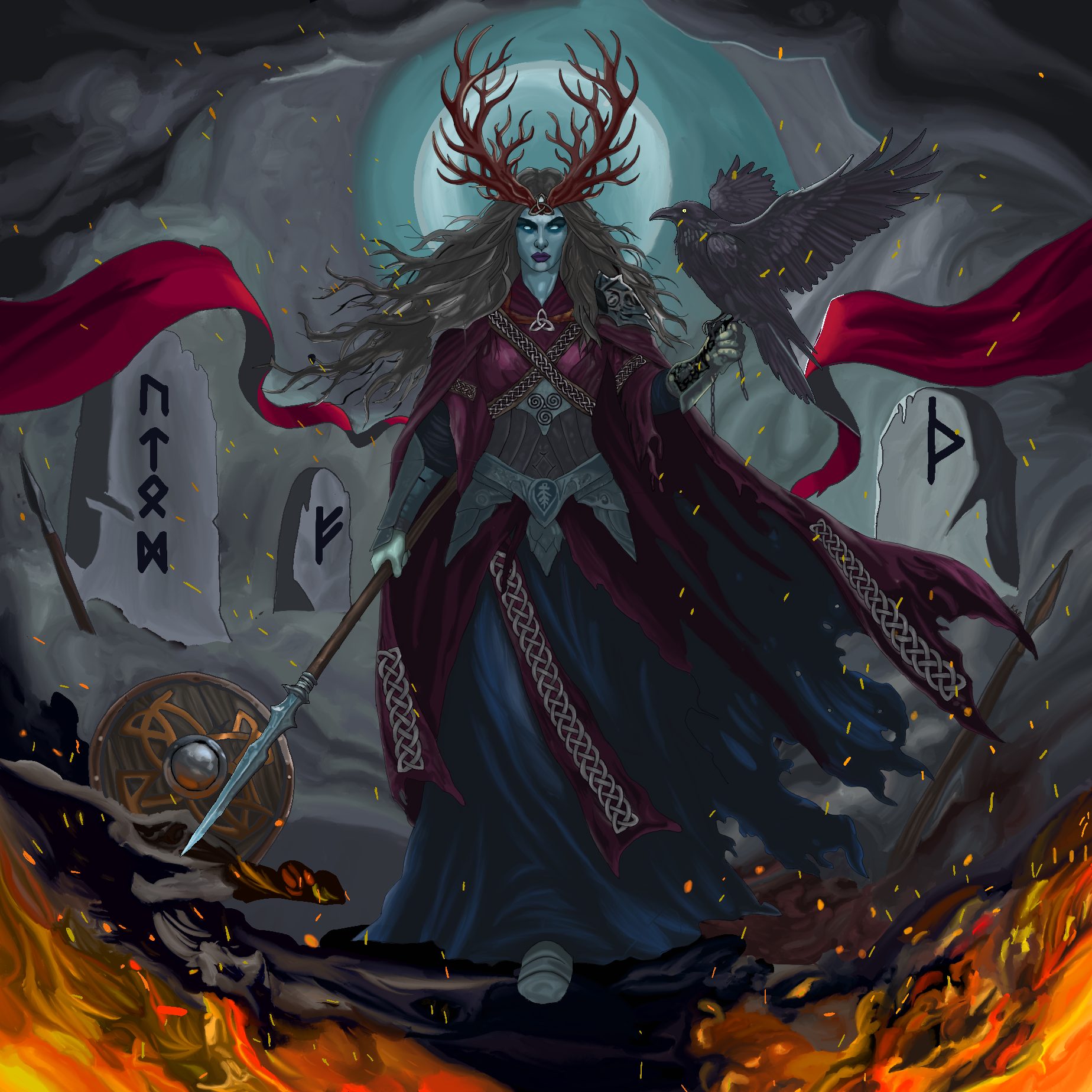
She stands where the battlefield ends and the beyond begins — antlered, cloaked in crimson, with a raven at her shoulder and fire at her feet. Original artwork by KAEs Studio Creations.
There are goddesses who comfort, and there are goddesses who clarify. The Morrigan belongs entirely to the second kind.
She does not offer solace. She offers truth — the kind that arrives at the edge of a battlefield, in the glossy eye of a circling crow, in the voice of a woman washing the armor of the soon-to-be dead. She is war, fate, and sovereignty braided into a single dark figure who has never been fully tamed by scholarship, folklore, or centuries of Christian reframing. She remains, even now, one of the most potent and unresolved figures in all of Celtic mythology — and arguably one of the most urgently necessary.
If you've felt drawn to her image, her crows, her relentless refusal to soften, this is your primer.
Origins and the Etymology of Her Name
The Morrigan — sometimes spelled Morrígan — appears most prominently in the Irish mythological tradition, particularly in the texts of the Ulster Cycle and the Mythological Cycle, preserved in medieval manuscripts like Lebor na hUidre (The Book of the Dun Cow) and Cath Maige Tuired (The Battle of Mag Tuired). She predates these manuscripts by centuries; what we have are echoes of a far older oral tradition.
Her name has been the subject of genuine scholarly debate, and the tension between interpretations is worth sitting with.
The most widely cited reading derives from Old Irish: Mór (great) + Rígan (queen) — making her, simply and overwhelmingly, the Great Queen. But a competing etymology pulls from a reconstructed Proto-Celtic root, reading Moro- not as "great" but as "terror" or "phantom." In this reading, she becomes the Phantom Queen — something spectral, liminal, not entirely of the living world.
Both are true to her character. She is great in the sense of enormous, encompassing, impossible to reduce. And she is phantom in the sense that she moves through states — woman, crow, eel, wolf, old hag — never fully caught in any one form.
The Triple Goddess: Badb, Macha, and the Others
The Morrigan is rarely singular. She functions most powerfully as a triadic figure, and the specific composition of her trinity shifts across sources — which is itself a clue to how she was understood. She is not a fixed deity but a principle, capable of manifesting differently depending on what the moment requires.
The most common configuration names her aspects as Badb, Macha, and Nemain — though Anu (or Anand) is sometimes substituted for Nemain, and some texts treat the Morrigan as one member of the trio rather than its collective name.
Badb (sometimes Badb Catha, "battle crow") is the most overtly terrifying. She appears as a hooded crow on the battlefield, feeding on the dead, her screaming cry an omen of death. She is prophecy as horror — she knows who will fall before the spear ever lands.
Macha is older and more layered. She carries within her a sovereignty goddess of the land, a racing warrior woman, and a suffering figure cursed by men's pride. In one legend, she is forced to race horses while heavily pregnant; in another, she is the mythic founder tied to the site of Emain Macha (Navan Fort). She carries the grief of the body — the way land and woman are both claimed, violated, and endured.
Nemain means something close to "frenzy" or "panic." She is the spirit of battle-madness, the force that makes men fall on their own swords, that turns the air of a battlefield into something thick with dread. She is chaos that is not random but purposeful — the terror that breaks formations.
Together, they do not so much add up as multiply. The Morrigan as a trinity is the complete experience of war, prophecy, and power: the omen, the land-claim, and the madness that ends things.
Her Symbols: Crows, the Ford, Shape-Shifting, and Prophecy

The Morrigan's sigil: twin ravens flanking a triquetra, bound in Celtic knotwork. Symbol of her triple nature — war, sovereignty, and fate. Original artwork by KAEs Studio Creations.
If you want to understand the Morrigan intuitively, watch a crow. Watch the intelligence in its eye, the way it studies you without fear, the way it returns again and again to the same territory. Crows remember faces. They hold grudges. They mourn their dead.
The crow and raven are her primary symbols, and they tie her to the battlefield in the most visceral sense — scavengers who arrive after the killing is done, who pick clean what war leaves behind. But in the Morrigan's tradition, the crow is not simply a symbol of death. It is a symbol of witness. The crow sees everything. The crow knows.
Shape-shifting is perhaps her most destabilizing quality. She is recorded transforming into an eel, a wolf, a heifer, a beautiful young woman, a bent old hag, and of course the crow. This fluidity is not trickery for its own sake. Each form serves a function — she is testing, challenging, disguising, pursuing. The shape-shifter cannot be fully known, cannot be fully controlled. She is sovereignty in its truest sense: belonging to herself alone.
Prophecy runs through all of her appearances. She prophesies victory for the Tuatha Dé Danann at the Second Battle of Mag Tuired; she prophesies death for Cú Chulainn; she recites, at the end of the same battle, a great poem that many scholars read as both a vision of flourishing and a haunting echo of its end. The Morrigan's prophecies are true. They are also terrible. She does not tell you what you want to hear — she tells you what will be, and leaves you to metabolize it.
And then there is the washing at the ford. This image appears across Celtic lore: a woman, sometimes weeping, washing bloodied armor or the severed limbs of warriors at a river crossing. She is called bean nighe in Scottish Gaelic — the washerwoman, the laundress of the dead. To encounter her is to know you are about to die. The ford is a threshold — between one bank and another, between living and what comes next. The Morrigan stands there, knee-deep in cold water, washing what cannot be made clean.
The Ulster Cycle: Cú Chulainn and the Great Refusal
The most famous encounter between the Morrigan and a mortal is her complicated, devastating relationship with Cú Chulainn, the great warrior of Ulster.
Their first meeting in Táin Bó Cúailnge (The Cattle Raid of Cooley) sets the tone immediately. She appears to him as a beautiful woman, announces who she is, and offers him her love and her aid in his coming battle. Cú Chulainn, with breathtaking arrogance, refuses her. He tells her, essentially, that he has no need of a woman's help in warfare.
This is not merely rudeness. In the mythological logic of Celtic sovereignty, the goddess of the land offers herself as a test — to accept her is to receive the sanction of the land itself, to be recognized as a worthy ruler or champion. To reject her is to reject sovereignty, to declare yourself outside the sacred order of things. Cú Chulainn's refusal is a declaration that he stands alone, beholden to nothing greater than himself.
She does not forget. In the subsequent battles, she appears three times in animal form to hamper him — as an eel tangling his feet in a ford, as a wolf stampeding cattle across his path, as a heifer driving confusion into the fray. He injures her each time. And then she appears once more as an old woman milking a cow, and he, not recognizing her, unknowingly blesses her three times, healing each wound he inflicted.
The final note of their story is the most haunting. As the mortally wounded Cú Chulainn dies lashed to a standing stone — famously refusing to fall even in death — the Morrigan lands on his shoulder as a crow. It is read as many things: vindication, grief, completion. She was with him from the beginning. She is there at the end. Whether this is cruelty or a terrible kind of love is left, deliberately, unresolved.
What She Represents: Shadow Work, Sovereignty, and Grief as Power
To engage with the Morrigan — in myth, in spiritual practice, in art — is to engage with things that do not soften for comfort.
Sovereignty, in the mythological sense, is not authority over others. It is authority over the self. It is the refusal to abandon your own nature to please, placate, or perform. The Morrigan's challenge to Cú Chulainn is, at its core, a question: Do you know what you are? His refusal is not just arrogance — it is a failure of self-knowledge. He cannot accept what she represents because he cannot face the parts of himself she mirrors back.
In contemporary spiritual practice, the Morrigan has become a powerful figure for shadow work — the Jungian process of confronting the parts of the self that have been suppressed, rejected, or denied. She does not permit avoidance. She brings the hidden thing into the light of the battlefield, where it cannot be ignored. This is not comfortable. It is also not optional, if you want to move forward.
She is also profoundly associated with transformation through grief. The bean nighe at the ford is not a figure of despair — she is doing work. The washing is ritualistic, necessary, a form of tending to what has been lost. Grief, in her tradition, is not weakness. It is sacred labor. The Morrigan teaches that we do not have to perform composure in the face of loss; we can keen, as the banshee keens, and let the sound of our sorrow do its work.
The Morrigan in Modern Culture: Dark Academia, Paganism, and the Living Myth
She is everywhere once you know to look.
In pagan and Wiccan practice, the Morrigan is one of the most actively revered Celtic deities, called upon for protection, for truth-telling, for sovereignty work, and for help in crossing thresholds of major life change. She is present in Samhain rites, in shadow integration practices, in the shrines of those who work with death as a spiritual teacher. Practitioners who work with her frequently describe her as exacting — she will hold you to what you've committed to, she will not let you minimize your own power, she will not let you play small.
In dark academia culture, she sits naturally alongside Hecate, the Morrigan's Greek counterpart in liminality, and within the broader aesthetic of scholarly mysticism — of knowledge that carries weight, of beauty that does not shy from darkness. She appears in artwork, in tattoo culture, in the imagery of practitioners who understand their spirituality as something rigorous rather than decorative.
In literature and popular media, she appears in everything from Neil Gaiman's American Gods to the pages of countless fantasy novels that owe a deep debt to Celtic mythology. She is difficult to write well — easy to flatten into simple menace, harder to render in her full ambiguity. The best portrayals hold the tension: she is neither villain nor ally. She is a force of nature that requires you to find your own footing.
The Morrigan at KAEs Studio Creations
The Morrigan artwork series in our collection was made for those who feel her presence — in the crows outside the window, in the moments when clarity arrives wrapped in discomfort, in the aesthetic language of dark academia and Celtic myth that speaks to something older than trend.
Each piece in the series was built with her symbols in mind: the dark wing, the threshold, the watchful eye that withholds nothing. If you've been searching for art that carries weight — that means something, that speaks the visual language of myth and shadow and the kind of beauty that does not apologize for itself — this series is for you.
Explore the Morrigan Collection at our Etsy shop, KAEs Studio Creations. Bring her home.
Further Reading
The Morrigan is a deep well. If this essay sent you reaching for more, these are worth your time.
Primary Sources
Táin Bó Cúailnge (The Cattle Raid of Cooley) — the central Ulster Cycle text; available in Thomas Kinsella's translation (The Táin, 1969) or Ciaran Carson's (The Tain, 2007)
Cath Maige Tuired (The Second Battle of Mag Tuired) — contains the Morrigan's great prophecy; translated by Elizabeth Gray (1982)
Lebor na hUidre (The Book of the Dun Cow) — one of the oldest surviving Irish manuscripts; partial translations available through academic sources
Recommended Reading
The Morrigan: Meeting the Great Queens — Morgan Daimler (a thorough, accessible guide for both scholarly and spiritual readers)
Pagan Portals: The Morrigan — Morgan Daimler (shorter introductory companion)
Celtic Mythology: Tales of Gods, Goddesses, and Heroes — Philip Freeman (readable overview of the broader mythological tradition)
The Lebor Gabála Érenn (The Book of Invasions) — for context on the Tuatha Dé Danann and their world