The Holly King & the Oak King: The Turning of the Year (and Why It Still Haunts Us)
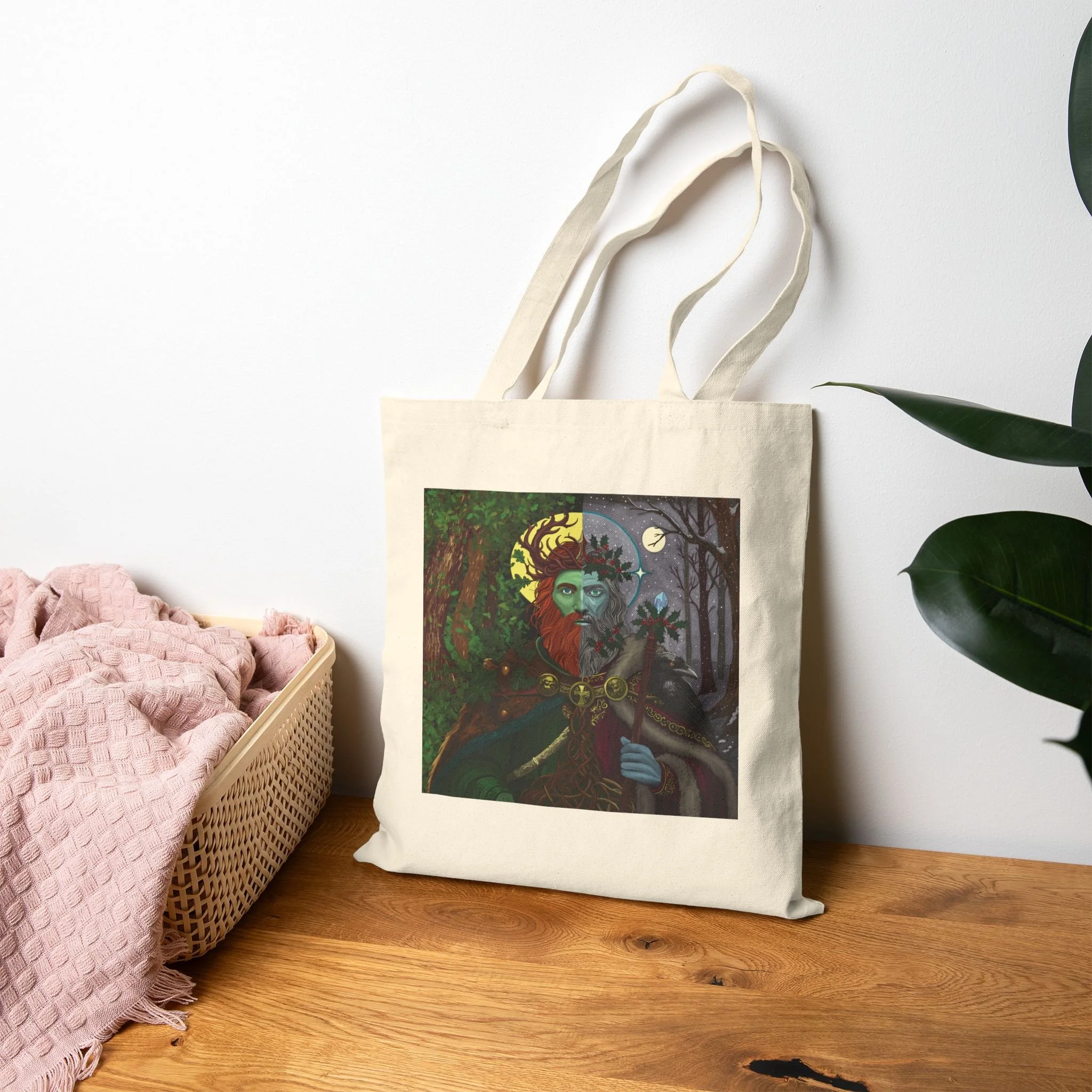
The Seasonal Kings, carried like a quiet crest—Oak and Holly in necessary succession.
There are stories that behave like weather.
They do not happen once. They return. They change the pressure in the air. They rearrange the light in a room. And if you’ve ever felt the year tilt—quietly, almost imperceptibly—then you already understand the premise of the Holly King and the Oak King.
In modern retellings, they are rivals who meet in symbolic combat at the solstices: one crowned in thorn and blood-bright berries, the other in green fire and thunderwood. But the older truth beneath the drama is simpler, and more unsettling:
They are not good and evil. They are succession.
They are the agreement the world keeps with itself—an old bargain of growth and rest, blaze and ember, leaf and bone.
The seasonal kings (and the problem with “battle”)
The Holly King and the Oak King are best understood as seasonal sovereignty—two faces of the year’s authority.
The “battle” is not a moral judgment. It is a transfer of power.
If you want a scholarly lens, treat the story as a symbolic mechanism: a way to explain (and endure) the fact that the world must change. The kings give shape to what is otherwise abstract—daylight lengthening, daylight shrinking, the long middle between.
And because the story is a pattern, it remains useful even when it isn’t December or June.
Yule and Litha: hinge points, not endpoints
Most modern versions place the kings at two turning points:
Yule (Winter Solstice): the longest night, the first return of light
Litha (Summer Solstice): the longest day, the first surrender of light
In the popular telling, one king “wins” at each solstice.
But a more precise reading is this: each solstice contains its opposite.
At Yule, darkness is at its greatest—and yet the light begins to return.
At Litha, light is at its greatest—and yet the dark begins to return.
This is why the myth endures. It refuses the fantasy of permanence. It insists that every height carries the seed of its decline, and every low point carries the first proof of ascent.
Holly: thorned endurance, bright blood, and the art of keeping
Holly is not a gentle plant.
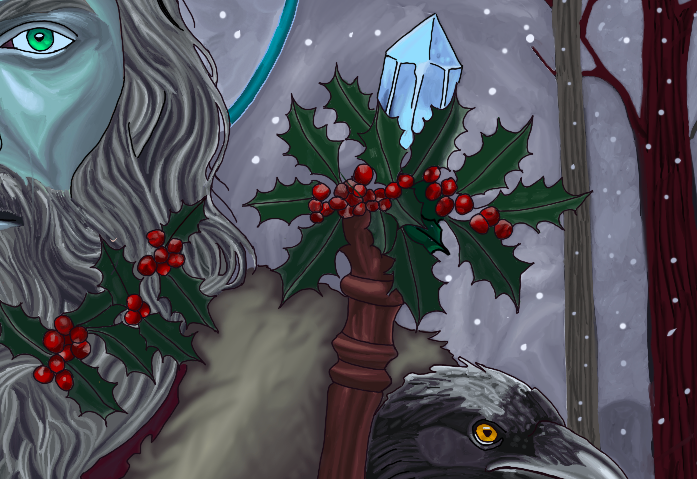
Holly and the watchful raven: protection, thresholds, and the hard season’s clarity.
It is glossy and armed. It holds its green when other things surrender. It bears berries like small, bright wounds—red punctuation against winter.
In symbolism, holly gathers meanings that feel protective and severe:
Endurance: staying green through the hard season
Protection: thorned boundaries; the threshold guarded
Vitality in scarcity: berries as winter’s stubborn color
Hearth-keeping: the work of holding warmth, holding memory
If the Oak King is expansion, the Holly King is continuance—the fierce, quiet insistence that life persists.
Oak: rooted authority, growth, and thunder in the branches
Oak is a different kind of power.
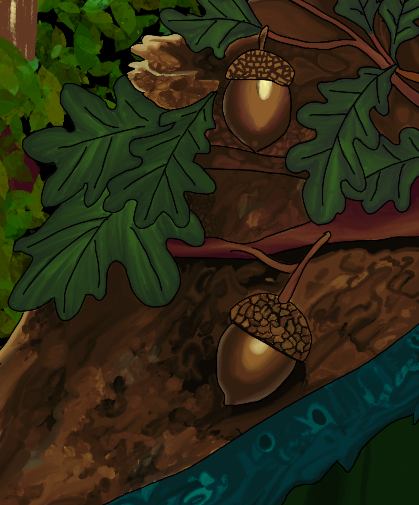
Acorns: the future held in miniature—an entire season waiting in a seed.
It is not sharp; it is heavy. It does not defend with thorns; it defends with presence. Oak grows slowly, and then it stays.
Across Celtic and broader European symbolism, oak is frequently associated with:
Strength and stability: the rooted thing that does not easily move
Growth and sovereignty: the green season’s authority
Storm and thunder: the sky’s voice in the branches
Sacred space: groves, thresholds, old trees as witnesses
Where holly is the guarded threshold, oak is the pillar.
The long middle: why this story matters beyond the solstices
If you only read the Holly King and Oak King as a holiday myth, you miss the part that makes it useful.
Most of life is not a solstice.
Most of life is the long middle—the weeks when something is changing, but you cannot yet name what it will become.
This is where the kings live as metaphor:
When you are building something (Oak), but still carrying the memory of what you survived (Holly)
When you are thriving (Oak), but learning to respect the cost of constant brightness
When you are resting (Holly), and discovering that rest is not failure—it is strategy
The kings give you permission to be seasonal.
They remind you that there are times for growth and times for keeping, and neither is a moral flaw.
Berries and acorns: small symbols with heavy weight
Berries and acorns are the kind of symbols folklore loves: small, ordinary, and inexhaustible.
Berries are brightness in scarcity—proof that color survives the cold
Acorns are potential made physical—an entire tree held in a small, hard seed
Together they make a quiet thesis:
What you keep (Holly) becomes what you grow (Oak).
The raven: witness, omen, and keeper of thresholds
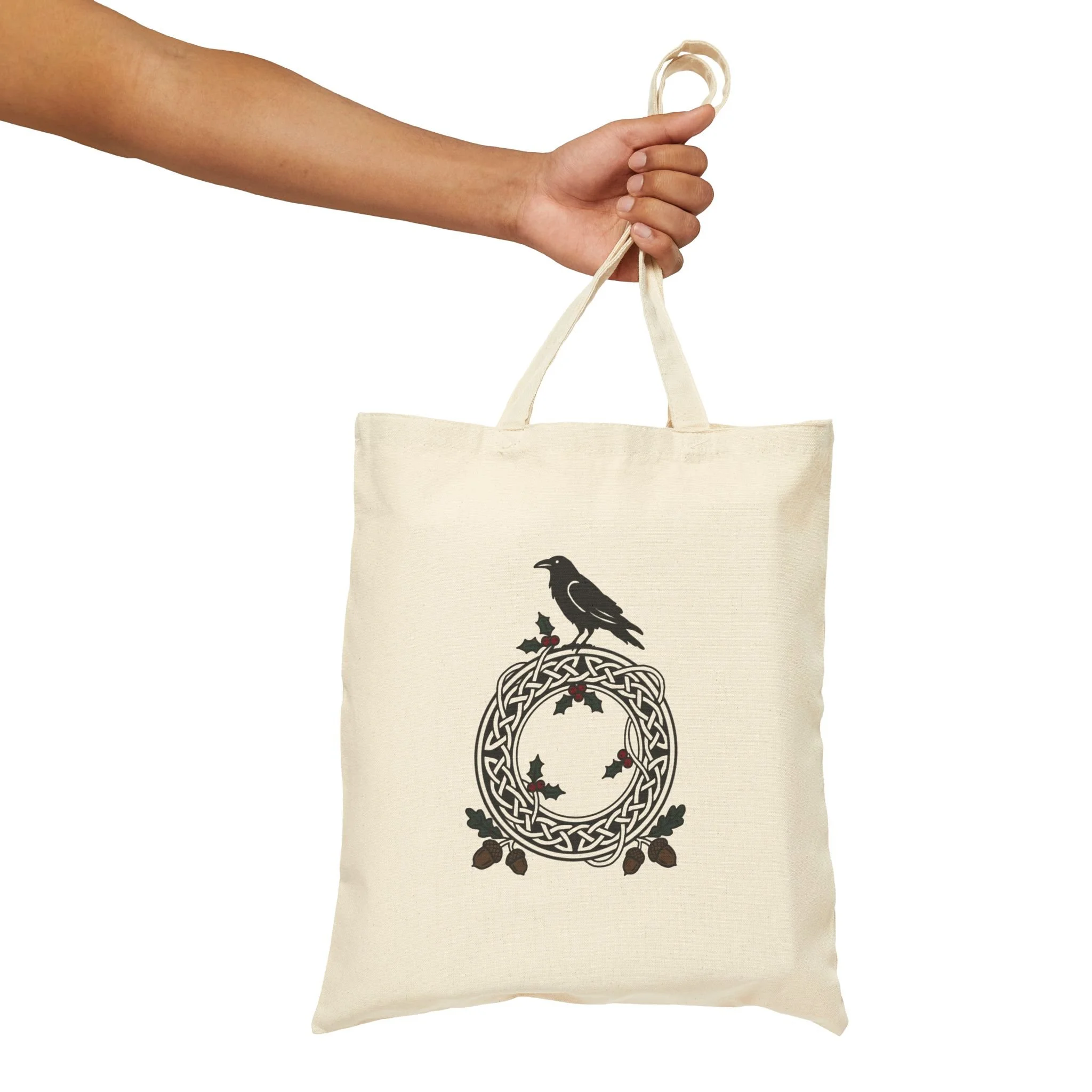
The raven as witness: a quiet crest for thresholds and turning seasons.
The raven belongs to liminal stories.
It is a watcher at the edge of the field. A scholar of carrion and crown. A creature that understands cycles without sentimentality.
In the context of the seasonal kings, the raven reads as:
Witness: the one who sees the transfer of power
Omen: not “bad luck,” but information—change is coming
Threshold-keeper: perched between what was and what will be
If you keep a visual system for this myth, let the raven be the narrative anchor: the eye that follows the turning.
Shop the Seasonal Kings (Etsy)
If you’d like to carry this myth into the everyday, you can find the Holly King & Oak King pieces in my Etsy shop: