Tuberose and the Spider: Night Blooms, Mourning Rites, and the Flowers That Watch You Sleep
Mythology Classroom
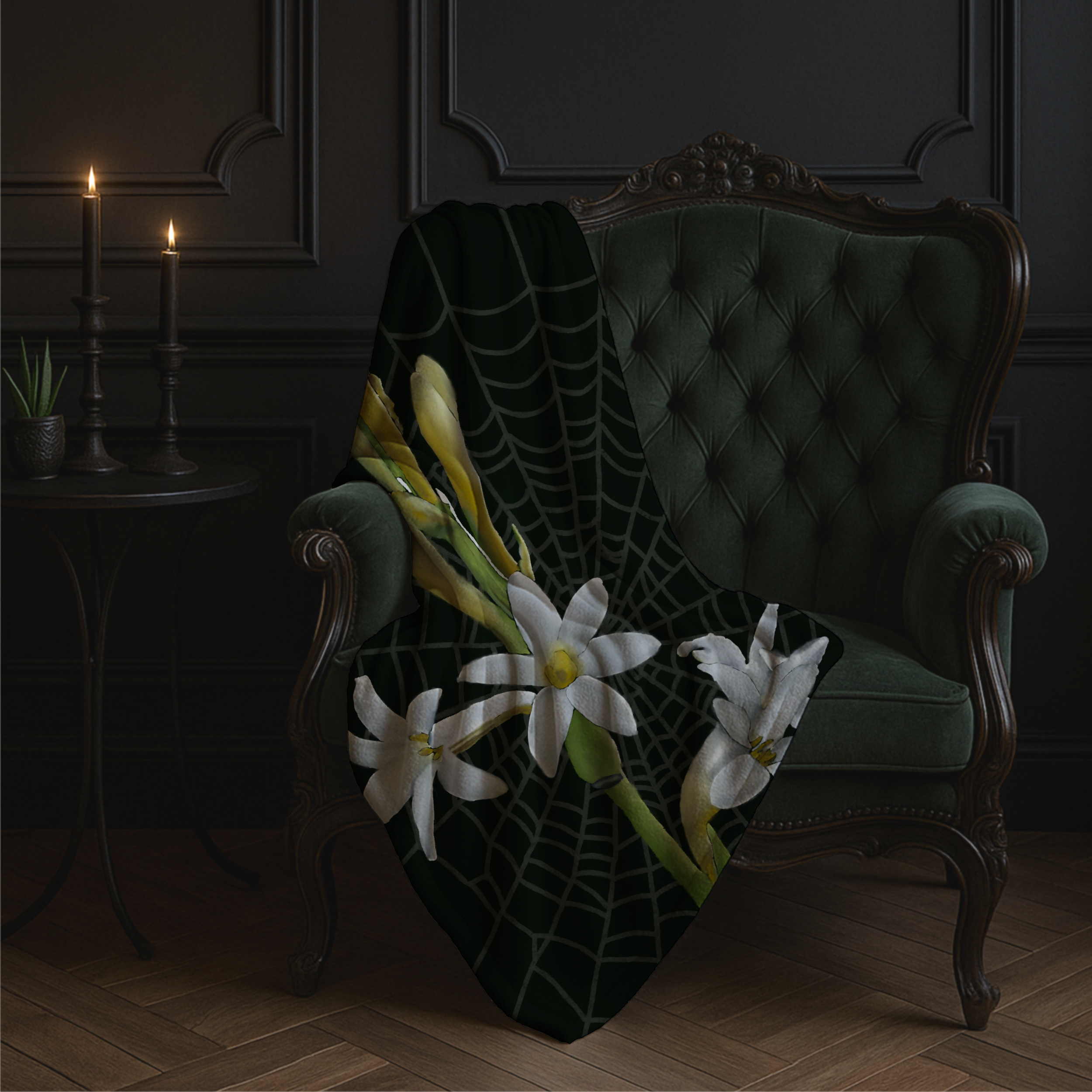
Not all flowers are meant for daylight.
The tuberose — Agave amica, once Polianthes tuberosa, a name that still carries something of its original strangeness — belongs to the night. Its waxy, cream-white blossoms open after dark. Its perfume, which is dense and narcotic and almost too much in an enclosed space, intensifies as the sun goes down. The tuberose does not court the living world. It courts whatever comes after.
It has always known exactly what it is.
A Flower of the Dead
In France, the tuberose was called la tubéreuse and was so firmly associated with death and funerary use that well-born young women were sometimes forbidden from smelling it in the evening, lest they be overcome. This was not entirely superstition. The flower's scent — which contains compounds that affect the nervous system — genuinely intensifies after dark, when other volatile molecules released earlier in the day have dissipated. The night air concentrates it.
The association with death was widespread and ancient. In Hindu tradition, tuberose has long been used in garlands offered to deities and in funeral rites. In Mexico, nardo — the Spanish name — is threaded into Day of the Dead altars alongside marigolds. In Victorian England, it lined the parlors where the dead were laid out, its scent understood as both tribute and vigil.
There is a curious logic here. A flower that blooms only in darkness, only in the hours belonging to the unconscious and the dreaming mind — what else should it be for, if not the threshold between one world and the next?
The Night-Bloomer's Reputation
In India, there is a folk belief that unmarried girls should not smell tuberose after dark, because the flower calls the spirit outward. In various traditions across South and Southeast Asia, night-blooming flowers are viewed with a degree of wariness — their nocturnal perfume understood as an invitation, though precisely to what remains deliberately vague.
The Aztecs cultivated tuberose long before European contact. They called it omixochitl — bone flower — a name that requires very little interpretation.
Bone flower. Consider what was already understood about this plant.
Arachne and the Web
The spider has its own mythology, older than almost anything we have inherited.
In Greek myth, Arachne was a mortal weaver of such skill that she challenged Athena herself to a contest. The goddess, having lost or refused to acknowledge defeat, destroyed Arachne's work. Arachne, unable to bear the humiliation, hanged herself. Athena transformed her — into a spider, condemned and gifted simultaneously: to spin forever.
The web is thus, in its mythological origin, an act of grief given form. A structure built by compulsion, out of loss.
There is something in this pairing — the tuberose and the spider — that resonates at a level beyond the decorative. Both belong to the night. Both are associated, across cultures, with the liminal space between living and dying. The tuberose blooms open in the dark and announce themselves with a scent that the living find both beautiful and unsettling. The spider spins in the dark a structure that traps, that catches, that holds.
It is not a coincidence that the web is also an image of fate. In Norse mythology, the Norns spin and weave the threads of human destiny. In many folk traditions, spider silk is believed to carry protective or prophetic properties. The web catches things that were passing through.
What Was Caught
Our Tuberose with Spiderweb design places these two symbols in deliberate conversation. The night bloom and the web: beauty and the structure that surrounds it; fragrance and the architecture of patience; the flower that opens toward death and the spider who spins fate.
This is not casual decoration. It is a meditation, rendered in ink and art.
For those who want their walls to carry this weight — to hold the older, stranger meanings that most design is content to forget — you will find it among our prints at kaesstudiocreations.etsy.com .
Bring the night bloom indoors.