The Poppy's Dark Secret: Sleep, Death, and the Forgotten Language of Flowers
Mythology Classroom
There is something deeply suspicious about a flower this beautiful.
The poppy sways in the field with a kind of careless elegance — paper-thin petals the color of arterial blood, a center dark as ink — and it looks entirely too at ease with itself for something so closely associated with oblivion. You do not come to know the poppy gradually. It announces itself. And then it waits.
It has been waiting, as it turns out, for a very long time.
The God in the Garden
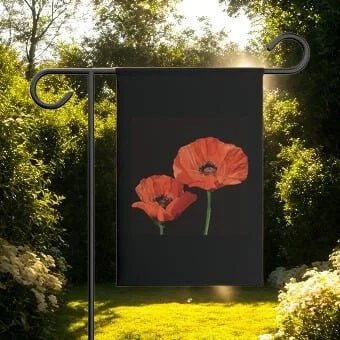
It blooms at the threshold. The Poppy garden flag — for porches, patios, and anyone who knows a garden should say something.
In Greek mythology, the poppy belonged to Morpheus, god of dreams, and to Hypnos, his father — god of sleep. Their home was a cave at the edge of the underworld, surrounded by poppies, through which flowed the river Lethe: the water of forgetting. This was not accidental placement. The poppy was the mechanism. The flower that carried the living to the edge of the dead.
Demeter, in her grief over the abduction of Persephone, was said to have been given poppies by the other gods — not as comfort, exactly, but as anesthesia. The flower that could make a grieving mother sleep when grief made sleep impossible. There is something bleak in that offering. Something that speaks to a particular understanding of sorrow: that sometimes the kindest thing the world can give you is temporary erasure.
The Romans built statues of Somnus — their own god of sleep — with poppies in his hand. His twin was Mors: death.
The iconography was never subtle.
Memoria and the Soldier's Field
The association between the poppy and remembrance is well known, largely through the tradition established after the First World War — the red poppy blooming wild across the disturbed soil of Flanders Fields, read by a generation of grieving families as proof that beauty could persist even where men had fallen. John McCrae's 1915 poem fixed the image permanently in the cultural imagination.
But the poppy's association with the dead predates the twentieth century by thousands of years. In ancient Egypt, poppies were placed in tombs. In ancient Greece, they were carved into funerary stelae. The Romans scattered them on graves. Across cultures separated by centuries and geography, something in the poppy's appearance — the deep red, the way its petals fall so easily, the way it droops in the heat — was read as an emblem of transience.
This was a language everyone spoke, even without knowing it.
The Victorian Apothecary Shelf
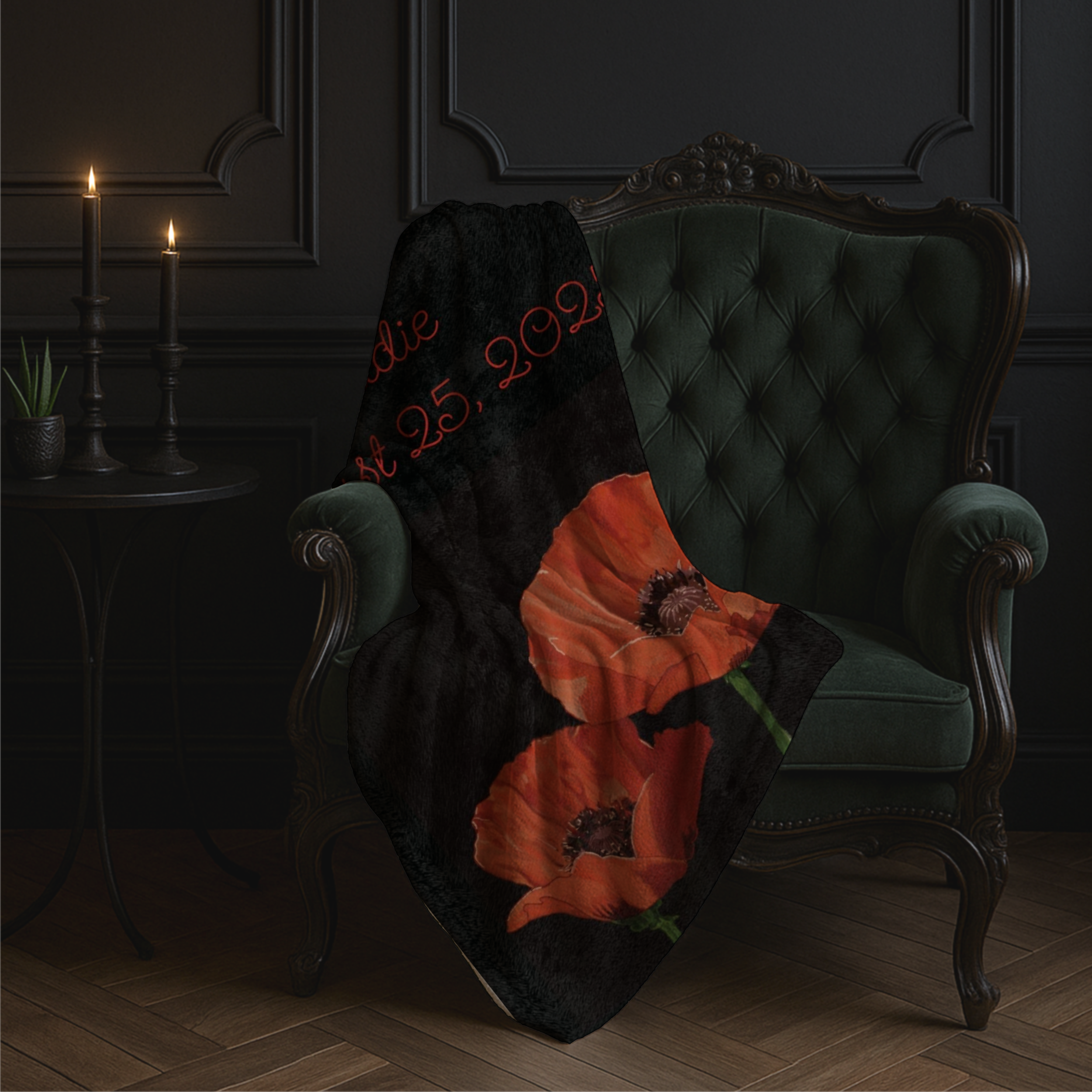
Where it began: the original illustration, rendered in the spirit of a Victorian natural history plate. Every petal placed with intent.
In the Victorian era, the poppy moved indoors. It appeared on wallpapers, on ceramics, in the ornate margins of pressed flower collections. It was considered — with characteristic Victorian ambivalence — both a symbol of consolation and a symbol of danger. Laudanum, an opium tincture, sat on the apothecary shelf alongside the rose water and the smelling salts. Poppy syrup was given to teething children. The flower's soporific qualities were well understood, and well used.
This duality suited the Victorian sensibility perfectly. A culture that celebrated mourning jewelry made from human hair was not squeamish about the aesthetics of something slightly sinister. The poppy was beautiful and it was dangerous and it was useful for grief. It belonged, in other words, exactly in the Victorian parlor.
The Poppy in the Dark Academia Imagination
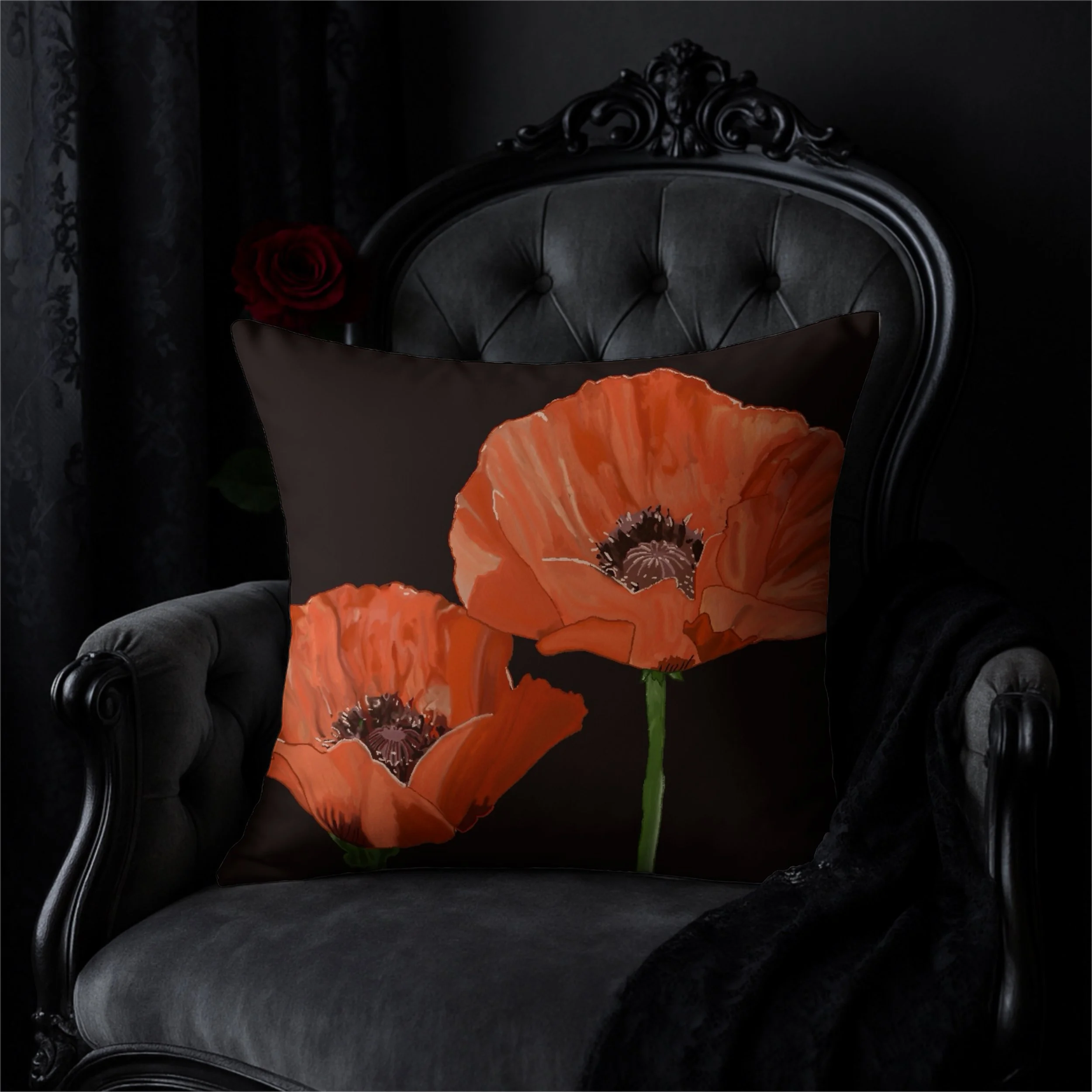
The poppy has always known where it belongs — in the dark, beside the things we keep close. Poppy pillow, available in the shop.
For those of us who are drawn to the darker registers of history and art — to manuscript margins and apothecary aesthetics, to the symbolic grammar of forgotten traditions — the poppy is an irresistible emblem. It carries centuries of meaning in its petals. It asks to be read.
It is the flower that says: I know what oblivion tastes like. I have been there before you, and I will be there after.
This is the flower at the heart of our Poppy design — rendered in the spirit of a Victorian natural history plate, with the attention to detail and the quiet menace that the poppy deserves. It is not decorative in the usual sense. It is commemorative. It is an argument that beauty and darkness are not opposites.
If your walls should carry meaning — if your home should feel like a place where the symbolic weight of things is taken seriously — you will find it in our shop at kaesstudiocreations.etsy.com .
The poppy is waiting for you. It has been waiting for a very long time.