The Morrigan Across Cultures: War Goddesses, Sovereignty Figures, and the Universal Shadow of the Feminine Divine
Mythology Classroom | Part II of the Morrigan Series
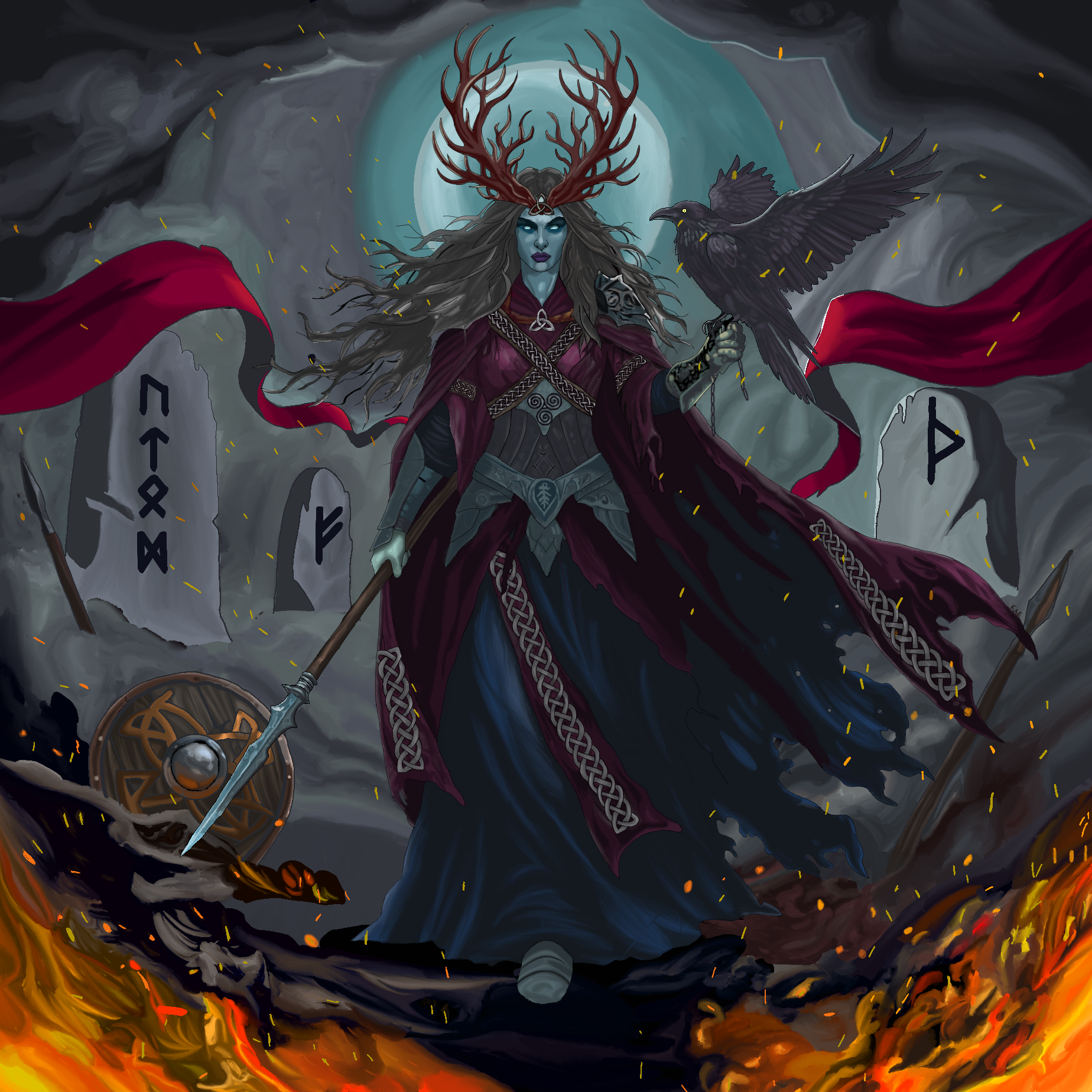
She stands where the battlefield ends and the beyond begins — antlered, cloaked in crimson, with a raven at her shoulder and fire at her feet. Original artwork by KAEs Studio Creations.
She is the crow on the battlefield. She is the hag at the crossroads. She is the goddess who does not beg for your attention — she simply appears, and you know something has irrevocably shifted. In Part I of this series, we explored the Morrigan as she lives and breathes in Irish mythology: her triple nature, her role in the Ulster Cycle, her connection to sovereignty, and the way she continues to resonate with modern practitioners of shadow work and dark academia aesthetics alike.
But the Morrigan is not alone in the dark. She has kin — figures across mythological traditions who share her battlefield, her liminality, her willingness to stand at the edges of life and speak with the voice of transformation. This installment turns the lens outward, into comparative mythology, to ask a question that has preoccupied scholars for generations: why does this archetype keep appearing? Why, from the Norse halls of Valhalla to the smoke-blackened temples of Kali, do we keep meeting versions of the same fierce, sovereign, death-touched feminine?
The answer, as with most things in mythology, is both historical and deeply human.
The Valkyries: Choosers of the Slain, Servants of a Different Court
Of all the Morrigan’s mythological parallels, the Valkyries of Norse tradition are perhaps the most visually immediate. Like the Morrigan, the Valkyries wheel above battlefields as shape-shifted birds — ravens and swans both appear in their lore. Like the Morrigan, they decide who lives and who falls. Like her, they are associated with the liminal moment between life and death, the sacred threshold of the slain warrior’s passage.
The word valkyrja means, quite literally, “chooser of the slain.” These figures — Brynhildr, Göndul, Skuld, and their sisters — descended upon battlefields not as passive observers but as active agents of fate, selecting the worthy dead for transport to Valhalla. The parallels with the Morrigan’s battlefield appearances in Irish myth are striking: both traditions give us supernatural feminine figures clothed in the imagery of ravens and war, both emphasize choosing and determining destiny rather than simply witnessing it.
But here is where the resemblance fractures, and the difference matters.
The Valkyries serve Odin. Their role, however powerful, is fundamentally one of service to a patriarchal divine order. They are agents of Valhalla’s court, executors of Odin’s will for the accumulation of warriors for Ragnarök. Their sovereignty over the slain is delegated authority. The Morrigan serves no one. She is sovereignty itself — not its handmaiden, but its embodied principle. When she appears on the battlefield or at a river ford, she does so on her own terms, following her own inscrutable designs. No divine king commands her movements. This is not a minor distinction. It is, arguably, the defining one.
The Valkyries exist within a hierarchical cosmic order; the Morrigan is an order unto herself.
Hecate: The Torchbearer at the Threshold
Turn from the Norse tradition southward to the ancient Greek world, and the Morrigan finds a different kind of echo in Hecate — goddess of magic, crossroads, and the liminal spaces between worlds.
Like the Morrigan, Hecate is a figure of profound ambivalence. She is not easily categorized as beneficent or malevolent, as she defies the comfortable binaries of later patriarchal theology. She appears at thresholds: the crossroads where three roads meet, the doorways of homes, the boundary between the world of the living and the realm of the dead. She carries torches to illuminate what the light of day refuses to show. Her sacred animals include dogs and serpents — creatures of both the underworld and the liminal space — where the Morrigan’s are crows and ravens, birds whose association with death and transformation runs similarly deep in the Celtic world.
The triple form is another powerful resonance. Hecate is frequently depicted as a triple goddess — three bodies back to back, facing outward in all directions at a crossroads, seeing all possible paths simultaneously. The Morrigan’s triple nature (Badb, Macha, and either Anand or Nemain, depending on the source) is constructed differently — three aspects of a single being rather than three simultaneous bodies — but the underlying symbolism converges on the same archetype: the feminine divine that encompasses all possibility, including the dark ones.
The witch archetype that runs so strongly through both figures is not accidental. In the post-pagan reimagining of both traditions, the liminal goddess who stands at the threshold and speaks of death and transformation becomes, inevitably, the witch. Both Hecate and the Morrigan have been reclaimed by modern Wiccan and pagan traditions for this reason — they speak to the power that lives precisely where polite religion refuses to look.
Kali: Destruction as an Act of Love
Of all the comparisons in this essay, the one between the Morrigan and Kali requires the most careful handling — not because the parallels are thin, but because the cultural contexts are so distinct that careless conflation does a disservice to both traditions. This is not appropriation; it is recognition. And the recognition is genuine.
Kali, in the Hindu tradition, is the goddess who dances on the corpse of Shiva on the cremation grounds. She wears a garland of skulls. Her tongue is extended, her eyes wide, her arms multiplied and full — she holds weapons, severed heads, and simultaneously makes gestures of blessing and protection. She is the destroyer. She is also the mother. She is the one who kills what must die so that life can continue.
The structural parallel to the Morrigan is unmistakable: both are battlefield goddesses associated with death and transformation, both are depicted with symbols of death that Western eyes tend to read as terrifying but their own traditions contextualize as necessary and even sacred. Both embody the creative-destructive duality that more sanitized mythologies distribute between separate divine figures — the life-giver here, the death-bringer there, kept safely apart. In the Morrigan and in Kali, these forces are not separated. They are the same hand.
A note on cultural distinctness: Kali emerges from Shakta Hindu theology, a living tradition with billions of practitioners, with specific devotional practices, philosophical frameworks, and scriptural contexts that are entirely its own. The parallels with the Morrigan are real and worth scholarly attention. They do not make these figures equivalent or interchangeable. They make them family, in the sense that human beings across vast distances and millennia have been grappling with the same profound and necessary truth: that transformation requires destruction, that the feminine has always contained this power, and that cultures which recognize it tend to produce richer — if more unsettling — theologies than those that suppress it.
The Cailleach: The Winter Hag and the Closest Kin
If the Valkyries are the Morrigan’s distant northern cousins and Kali her deep-time parallel from another cultural hemisphere, then the Cailleach is something closer: the next fold of the same cloth.
The Cailleach — the word means simply old woman or hag in Scottish and Irish Gaelic — is the winter goddess of Scottish and Irish tradition, the ancient sovereign of the land in her cold, hard, dormant season. She shapes mountains with her hammer. She rides storms. She is associated with the hardness of the earth in winter, with the death of the green world, and with the raw power that underlies the landscape itself. She is a shapeshifter. She is one of the most ancient figures in the Celtic mythological record.
Her connection to the Morrigan is structural and possibly etymological. Both are figures of sovereign femininity over the land. Both shapeshift. Both are associated with the darker half of the year’s cycle — the Cailleach with literal winter, the Morrigan with the winter of war and its aftermath. Both carry the association of the hag, the fearsome old woman who in many British and Irish folk traditions is revealed, if treated with respect, to be the guardian of the landscape’s deepest power.
The Cailleach is the Morrigan seen through the lens of season rather than battle — or perhaps the Morrigan is the Cailleach seen through the lens of war rather than weather. They are, in the deepest sense, the same archetype turning its face in two different directions. For those drawn to the Celtic mythology niche, the Cailleach is essential company for the Morrigan — the quiet, frozen version of the same sovereign truth.
The Morrigan in Modern Pop Culture: What Gets Her Right (and What Flattens Her)

The Morrigan's sigil: twin ravens flanking a triquetra, bound in Celtic knotwork. Symbol of her triple nature — war, sovereignty, and fate. Original artwork by KAEs Studio Creations.
The Morrigan has had a vivid second life in contemporary pop culture, and it is worth examining these appearances with some critical attention — not to diminish them, but because understanding what they get right (and wrong) deepens appreciation of the original.
Neil Gaiman’s American Gods features the Morrigan as one of the old gods struggling for relevance in a modern America that has forgotten her. Gaiman’s portrayal captures something essential: her ambiguity, her refusal to be made comfortable or comprehensible, her nature as a figure of change rather than simple destruction. He does not defang her. She remains genuinely unsettling, genuinely powerful, genuinely her own.
Kieron Gillen and Jamie McKelvie’s The Wicked + The Divine offers perhaps the most aesthetically interesting contemporary reimagining. The comic’s version of the Morrigan is theatrical, extreme, deeply embedded in the mythology’s symbolic language — her connection to music (a modern equivalent of battle fury), her triple nature rendered through costume and persona, her capacity for both annihilating love and genuine devastation. The series understands that the Morrigan is a figure of excess, of too much, in the best possible sense.
Where pop culture tends to flatten her is in narratives that reduce the Morrigan to a villain — an obstacle, a dark force to be overcome, the antagonist in someone else’s heroic journey. The Morrigan of the Ulster Cycle is not a villain. She is a force of nature with her own motives, her own sovereignty, her own code. When Cú Chulainn rebuffs her, he is not the hero defeating the monster. He is a man misunderstanding a goddess, and it costs him. That nuance — that the Morrigan is not opposed to humanity but rather holds it to a higher accounting — tends to disappear when she is cast simply as antagonist.
Why She Keeps Appearing: The Archetype That Will Not Sleep
Across the Norse fjords, the Greek crossroads, the smoke-wreathed cremation grounds of South Asia, the windswept Scottish highlands, and the corners of twenty-first century graphic novels and fantasy literature, this figure returns: the death-touched feminine, the sovereign who decides, the transformer who stands at the threshold and refuses to make destruction comfortable.
Why?
The most compelling answer is that this archetype articulates something human cultures have always known but periodically tried to forget: that death is not the opposite of life, but its intimate companion. That the feminine — in whatever form a given culture imagines it — is not inherently gentle, not inherently nurturing and accommodating, not a gentle counterbalance to masculine power but a sovereign force in its own right. That the dark half of any cycle is as sacred as the bright half, and that the figure who presides over that darkness deserves not fear but respect.
The Morrigan, the Valkyries, Hecate, Kali, the Cailleach — they share a refusal to be domesticated. They are the places where mythology refuses the comfortable story. And perhaps that is why, in an era that has grown newly hungry for complexity, for acknowledgment of the dark and difficult, for aesthetics that do not flinch from shadow, these figures have returned with such force to popular imagination.
The crow on the battlefield has been waiting. She is not impatient. She has all the time in the world.
Bring the Morrigan Home
The imagery and symbolism explored across this two-part series — the crow, the battlefield, the triple form, the sovereign darkness — is woven through the artwork at KAEs Studio Creations. If you’ve found yourself drawn to the Morrigan’s presence in these pages, explore the Morrigan collection in the shop. Each piece is designed to carry that same atmospheric weight: the dark academia aesthetic, the mythological resonance, the sense that beauty and shadow are not opposites but partners.
And if you missed Part I — the Irish origins, the etymology of her name, the Cú Chulainn encounter, the shadow work resonance — find it in the Mythology Classroom archive. The crow was waiting there, too.